How to Make Asking for Help a Priority in Caregiving

Wanting Help Without Guilt: Connie’s Story
Asking for help can be hard. Connie had been caring for her mother, who had early-stage dementia, for over a year. She cooked, cleaned and managed doctor appointments, all while working full-time and raising two pre-teen kids.
Her older siblings lived nearby, but Connie never asked them for help. “They have their own lives,” she told herself. But deep down, she felt exhausted, overwhelmed and alone. Still, the guilt held her back. She believed that asking for help meant she was failing as a daughter.
One evening while folding laundry, Connie reached a breaking point and came to tears. Her husband gently asked, “Why don’t you let someone else help, even just a little?”
That moment made her pause. Maybe it wasn’t weakness. Maybe it was time.
If you’ve ever felt like Connie, you’re not alone. This post will show you how to ask for help without guilt and why doing so is one of the bravest things you can do.
The Psychology of Asking for Help

Most caregivers know they need help. The hard part is actually asking for it. Understanding the psychology of asking for help can make that step a little easier.
Research in behavioral psychology shows that people avoid asking for help for a few key reasons: fear of judgment, the belief that asking is a sign of weakness, and the worry that others will say no. Caregivers carry all of these fears — and more.
Here’s what’s actually happening in your brain when you hold back: guilt and shame activate the same neural pathways as physical pain. So the guilt you feel about needing help? It genuinely hurts.
But here’s the flip side of that. Studies also show that asking for help can help strengthen relationships. When you let someone in and allow yourself to be a little vulnerable, you give them a chance to contribute. Most people feel good when they help someone they care about. Saying yes to help isn’t just good for you. It’s good for them too.
Understanding this can shift how you see the act of asking. It’s not a burden. It’s can act more like a relationship bridge.
Understanding the Roots of Caregiver Guilt
Whether you’re caring for an aging parent, a spouse with an illness, or a child with special needs, the responsibilities can pile up fast. You may feel like asking for help signals failure. Caregiver guilt creeps in and makes it even harder to reach out.
Why Guilt Is Common Among Caregivers
Guilt is a normal feeling for caregivers. You care deeply about the person you’re helping, and you want to do everything right. But the pressure to be perfect can be overwhelming.
You might think, “I should be able to handle this,” or, “If I ask for help, I’m letting them down.” These thoughts are common, but they’re also harmful. Recognizing this is the first step in dealing with caregiver guilt.
Types of Guilt Experienced by Caregivers
There are different kinds of caregiver guilt. Neurotic guilt comes from feeling like you’re not doing enough. Existential guilt shows up when you feel like you’re losing your own life in the process.
Some caregivers feel guilty for being impatient or for not spending enough quality time with their loved ones. Others feel judged by family or even by the person they care for. Knowing these types can help you understand what you’re feeling and why.
The Emotional and Physical Toll of Unresolved Guilt
If guilt is left unchecked, it can lead to serious problems. It may cause stress, anxiety and depression. You might find it hard to sleep, feel constantly tired or even get sick more often.
Over time, this can lead to caregiver burnout. That’s when you feel mentally, emotionally and physically drained.
Why Asking for Help Is Important

Understanding why asking for help is important can give you the push you need to actually do it. This isn’t just about making your day easier. The stakes are much higher than that.
When you carry everything alone, you become a single point of failure. If you break down — and burnout will eventually break you down — your loved one loses their primary caregiver. That’s not love. That’s a risk.
Here’s another way to think about it. It’s like you’re the CEO of your loved one’s care. A CEO who insists on doing every job — from scheduling to laundry — will eventually watch the whole operation fall apart. Delegating the smaller tasks frees you to focus on what only you can provide: emotional presence, medical advocacy and the relationship your loved one depends on.
One family caregiver described her experience this way:
“I ended up doing the cooking, the cleaning, maintaining the finances, doing taxes, the driving, buying the groceries, cooking the meals, doing the yard work, cleaning the basement, mowing the lawn… plus going to school.”
Does that sound like you?
That kind of load just isn’t sustainable. And it’s not what devotion looks like. It’s what collapse looks like.
When you ask for help, you protect your ability to show up tomorrow. You stay in the game. And that matters more than doing every task yourself today.
Overcoming the Stigma of Asking for Help

Reframe the meaning of “help” in caregiving.
Many caregivers see asking for help as a weakness. It’s actually a sign of strength. Getting help doesn’t mean you’re giving up. It means you’re making a smart choice to get the best care possible for your loved one and for yourself.
Think of help as a tool. It’s a tool that makes your job easier and makes you a more effective caregiver.
Acknowledge unmet needs without shame.
Sometimes, guilt is a signal that your own needs are being ignored. Maybe you’re skipping meals, losing sleep or missing your own doctor’s appointments. It’s okay to admit that you need care too.
Here’s where journaling can help. Try writing down how you’re feeling each day. Look for signs of stress or exhaustion. Once you know what’s missing, you can take steps to fix it without shame.
Let go of perfectionism and control.
You don’t have to do everything perfectly. Trying to control every detail just wears you out. It’s okay if things aren’t done exactly the way you’d do them.
Ask yourself: does the person who folds a towel or washes dishes really matter in the big picture of your loved one’s care? Almost always, the answer is no. Letting others help is a strategic choice. It keeps you in the game with energy to spare.
The Real Benefits of Asking for Help
Once you move past the guilt, the benefits of asking for help become clear fast. Here’s what can change when you stop trying to go it alone:
- Your physical health can improve. Chronic stress from caregiving raises cortisol levels, which can damage your heart, immune system and sleep quality. Sharing the load helps reduce that stress.
- Your mental health can stabilize. Feeling supported reduces anxiety and depression. You don’t have to carry this weight in silence.
- Your loved one can get better care. A rested, supported caregiver makes better decisions. You show up more present, more patient and more connected.
- Your relationships can grow stronger. Letting people help draws them closer. It gives friends and family a meaningful role in your loved one’s life.
- You protect the long game. Burnout ends caregiving journeys early. Sustainable help can keep you in your caregiving role for as long as your loved one needs you.
These aren’t small wins. They’re the difference between a caregiving journey that sustains you and one that depletes you.
Practical Strategies to Ask for Help Without Feeling Guilty
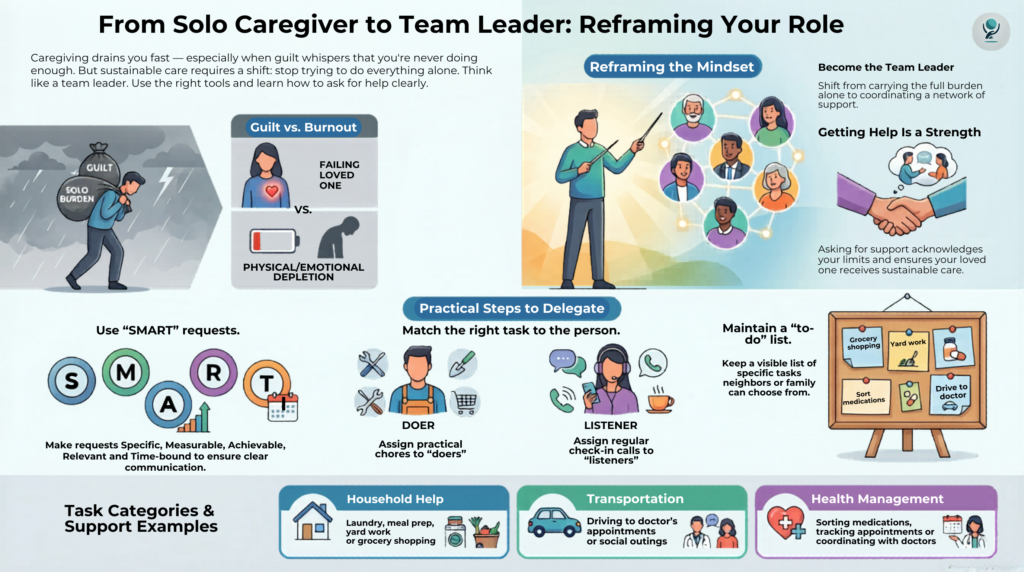
Start with small requests and clear communication.
Knowing how to ask for help starts with knowing what kind of help you actually need.
See how putting a care plan in writing can help.
Begin by asking for small things, like picking up groceries or sitting with your loved one while you take a break. Use clear and simple language. You can say something like, “I need help for an hour this weekend so I can run errands. Can you do that?”
Be honest and direct. People often want to help but don’t know what you need. Matching the right task to the right person makes it easy for others to say yes. Think in categories:
- Practical Helpers: Ask them to drop off a freezer meal or help with light housekeeping.
- Errand Runners: Neighbors already out and about. Ask them to grab a few items if they’re heading to the store anyway.
- Good Listeners: Long-distance friends or family. Schedule a weekly 20-minute call with one goal: to be heard.
- Skilled Support: Professional caregivers for personal care or scheduled respite time.
Take advantage of respite care and community resources.

Look into respite care services, which provide short-term breaks for caregivers. Many organizations like local nonprofits and senior centers offer support. You can also explore options like adult day care programs, home health aides and meal delivery services.
These services help you recharge while ensuring your loved one is well cared for.
Create a caregiving support team.
Don’t try to do this alone. Build a team of support. This can include family, friends, neighbors and professionals. Use group chats or shared calendars to coordinate tasks and share updates.
Online caregiver forums and social media groups can connect you with others who get it. A strong support system changes everything. Find a therapist near you.
Use organization as a form of respite.
Strong organization is one of the most underused tools in caregiving. When you write it down and plan it out, you free your brain from the constant hum of what you might forget.
A few tools that help:
- A care needs checklist: Map out your loved one’s needs versus your skills. Use it to spot exactly where you need to delegate.
- Medication charts: A 20-to-30-minute basic medication review with a pharmacist shifts the responsibility for accuracy from your shoulders to a professional’s.
- A medical emergency information kit: Keep essential medical info on your refrigerator so first responders have what they need in a crisis. Learn how “Vial of Life” kits work.
Building Emotional Resilience and Sustaining Well-Being
Develop a sustainable self-care routine.
Make time for yourself each day. It could be for as little as 10 minutes. Do something that refreshes you. Walk, read, journal or listen to music. Eat well, get enough sleep and try to move your body. A small self-care habit can have a big impact over time.
Learn more about creating a self-care plan.
Reframe negative self-talk and celebrate your wins.
Dealing with caregiver guilt starts in the mind — and that’s exactly where positive reframing helps most.
Catch yourself when negative thoughts pop up. Instead of saying, “I’m failing,” try, “I’m doing my best with what I have.” Celebrate small victories: a calm conversation, a clean room, a shared smile. Positive thinking builds confidence and reduces guilt.
Seek professional guidance when you need to.

If guilt feels overwhelming, talking to a therapist can help. Many counselors specialize in caregiver stress and emotional burnout. Therapy offers a safe space to talk, process feelings and learn about tools for dealing with caregiver guilt.
You don’t have to reach rock bottom to ask for professional help. Think of it as another form of self-care.
Stick to your assisted caregiving plan.
- Journal it out: Write down what makes you feel guilty. Seeing the source on paper can reduce its power.
- Say yes to help: The next time someone offers to help, accept it — no matter how small the offer may seem.
- Talk it out: Join a caregiver support group online or in your community. Sharing your experience can help lighten the load.
- Focus on progress: Celebrate what you managed to do today, not what you didn’t.
When Professional Care Is the Most Loving Choice
Many caregivers see moving a loved one to a professional care community as an admission of failure. It’s actually the opposite.
When a care community handles safety, medication management and daily logistics, your role shifts. You stop being the operator and go back to being the daughter, son or spouse. Your visits become quality time again — not chore lists and medical decisions.
Asking for that level of professional help isn’t giving up. It’s choosing to show up as your best self for the person you love.
Caregiver Guilt: The Bottom Line
Guilt doesn’t have to be part of your caregiving journey.
When you understand why you feel guilty, learn how to ask for help, and take care of yourself, you reduce stress and improve the quality of care you give.
The benefits of asking for help go far beyond a lighter to-do list.
Remember why asking for help is important — not just for you, but for the person counting on you. Asking for help is a strength. Start small, be kind to yourself, and know that help is out there.
Asking for Help Without Caregiver Guilt FAQ
Is it normal to feel guilty as a caregiver?
Yes, caregiver guilt is very common. It often comes from trying to meet high expectations while ignoring your own needs.
How can I ask for help without feeling like a burden?
Start small and be specific. Most people want to help but don’t know how. Clear communication makes it easier for both of you. Knowing how to ask for help — in clear, simple terms — removes the guesswork for everyone.
What are some free resources for caregivers?
Local nonprofits, government programs and community centers often provide respite care, support groups and educational resources at little or no cost.
How can I take care of myself while caregiving full time?
Build small habits like 10-minute breaks, healthy meals or short walks. Even tiny steps can help you feel more in control. The benefits of asking for help extend here too. More help means more room for self-care.
When should I consider talking to a therapist?
If guilt, stress, or sadness become overwhelming or start to affect your health, talk to a mental health professional. Dealing with caregiver guilt is real work, and a good therapist can help you carry it.
Disclaimer: This article is for information and education only. It is not a substitute for advice from a doctor, therapist, financial advisor, or lawyer. Every caregiving situation is different. Always talk to a qualified healthcare provider, mental health professional, financial advisor, or elder law attorney before making decisions about a loved one's care, health, or finances.
Read our full disclaimer for more information. If you or someone you are caring for is experiencing a medical or mental health emergency, contact 911 or your local emergency services. In the U.S., the 988 Suicide & Crisis Lifeline (call or text 988) is available 24/7.